
Customs Clearance Egypt (2026)
Prepare Your Cargo. Clarify Every Step.
Read the main guide
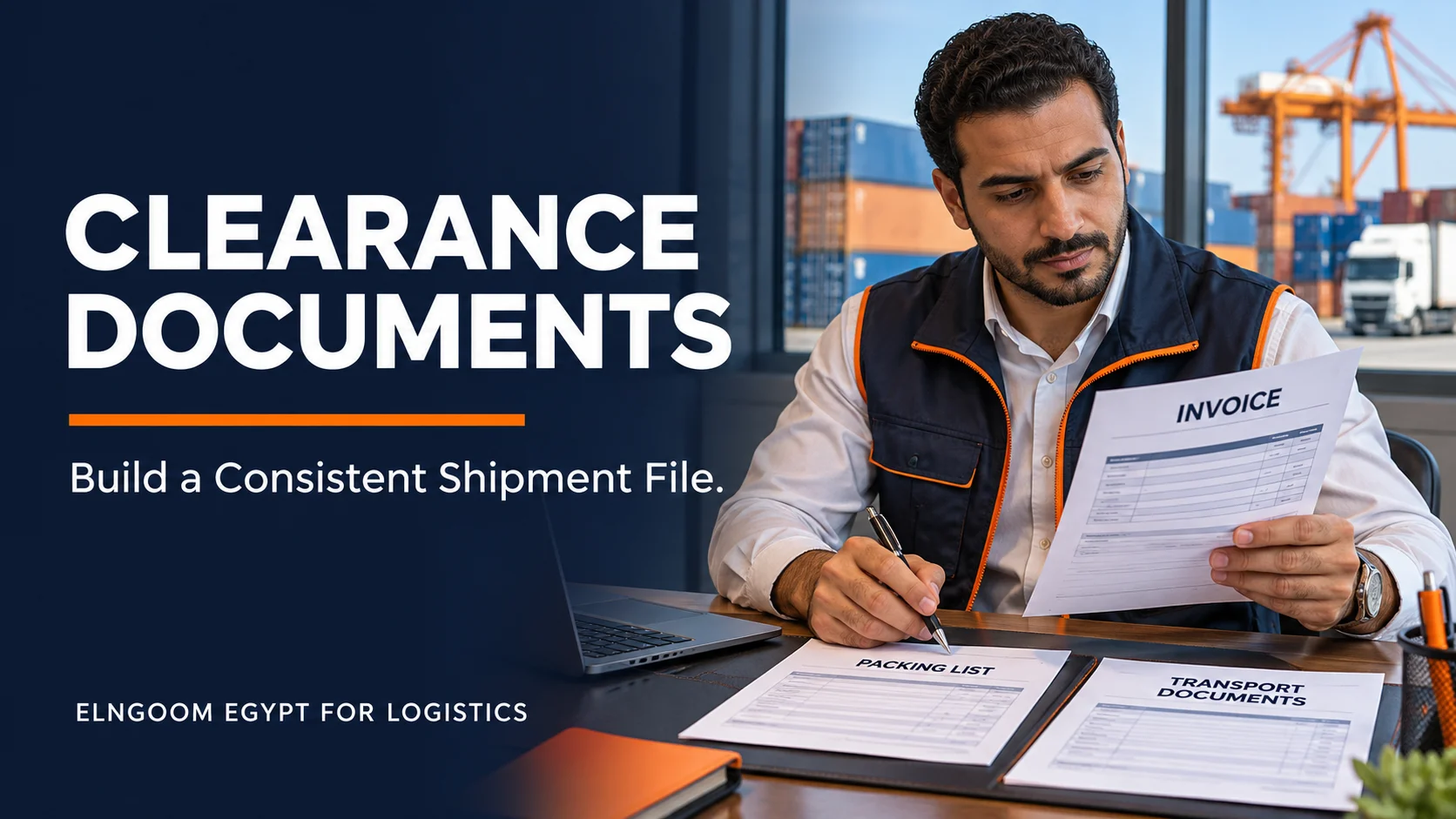
Egypt Customs Clearance Documents should form one consistent shipment file. This Egypt customs clearance checklist explains the documents needed for customs clearance, including the commercial invoice, packing list and transport document. Arrange a pre-shipment document review with ElNgoom Egypt to identify missing evidence before dispatch.
Request a shipment assessmentThe documents required for customs clearance in Egypt depend on the cargo, importer, origin, transport mode and customs procedure. A commercial invoice, packing list and transport document are common starting points, but they are not a universal or complete checklist. Confirm the final document set before shipment. Therefore, start the review before dispatch and agree ownership of missing evidence. Moreover, distinguish advance preparation, customs release and physical collection. Ask our commercial cargo support team for a shipment-specific scope and use the official single-window portal to check current services.
Check seller and buyer identities, product descriptions, quantities, values, currency and agreed terms. Make descriptions specific enough to connect each item to its specifications and proposed classification. Where goods are supplied free of charge, do not assume that stating a zero commercial price eliminates customs valuation requirements; ask what supporting valuation evidence is needed.
Record package counts, contents, net and gross weights, and identifying marks where relevant. Reconcile totals with the invoice and transport instructions. For mixed consignments, a clear item-to-package mapping can make physical examination and discrepancy resolution easier. Preserve model and serial information where it is relevant to the goods.
Review the bill of lading or air waybill against the shipment file. Confirm party names and shipment identifiers before the carrier finalizes its document. Origin evidence may be required, and claiming preferential treatment requires the applicable supporting evidence. Do not assume that the seller's country is necessarily the goods' country of origin.
The importer may need registration and tax evidence appropriate to its import purpose. The broker also needs the applicable authorisation. Depending on the product, specifications, conformity evidence or approvals from a competent authority may be relevant. These are product-dependent requirements, not a reason to collect every certificate mentioned in a generic online list.
For shipments subject to ACI, check the required ACID and party identifiers across the shipment documents and electronic file. Use CargoX's current required-documents guidance when preparing the submission. An uploaded file is not proof that all customs or product requirements have been met.
Assign an owner for every document, agree when drafts will be reviewed, and record any outstanding evidence. Confirm that invoice totals, packages, weights, party names and identifiers match. Ask the clearance provider to separate missing mandatory items from useful supporting information. Send drafts early enough to allow corrections before dispatch.
| Review area | Prepared approach | Unresolved approach | Action |
|---|---|---|---|
| Scope | Agree filing, attendance and collection tasks | Assume every task is included | Request a written scope |
| Importer | Confirm authority and receiving arrangement | Rely only on the freight booking | Resolve eligibility before dispatch |
| Goods | Provide item-level specifications | Use vague descriptions | Link products to invoice lines |
| Documents | Reconcile the final versions | Circulate inconsistent attachments | Keep a document register |
| Advance file | Assign registration and transmission owners | Treat a reference as customs release | Retain completion evidence |
| Cost | Separate fees, assessments and third-party tariffs | Compare headline totals only | Normalise quote assumptions |
| Timing | Track readiness, release and collection | Use one deadline for every shipment | Identify outstanding actions |
For a customs document review, compare the commercial invoice with the packing list, bill of lading or air waybill. Check descriptions, quantities, consignee information and values across the file. Also, confirm whether a certificate of origin and importer registration evidence are required for the actual transaction.
A commercial invoice review should record each discrepancy and the person responsible for correcting it. Then, confirm which originals, certifications or supporting records remain outstanding. Customs clearance requirements in Egypt depend on the goods and transaction, so a checklist supports the review rather than replacing shipment-specific confirmation.
First, identify the importer and the intended use of the goods before confirming dispatch. Ask which registrations and authorisations apply to the actual transaction. Moreover, separate importer responsibility from the broker’s filing role and the carrier’s transport role. Keep the responsible parties in a written shipment record. Resolve any uncertainty about the receiving arrangement before treating the commercial cargo file as ready.
CargoX guidance describes mandatory ACI filing for sea freight to Egypt and air freight from 1 January 2026. Therefore, coordinate the applicable workflow with the Egyptian-side party and overseas exporter. Reconcile party identifiers and document versions before dispatch. Moreover, retain registration and transmission evidence for follow-up. An advance shipment reference does not replace the customs declaration, applicable product controls or final release.
First, support the goods description with specifications, intended use, composition and other relevant product information. In addition, keep classification, transaction value and origin evidence as separate review items. Moreover, connect each invoice line to its supporting records when different goods require different treatment. However, a proposed code does not establish the entire final assessment. Ask which assumptions remain provisional and retain the evidence used for the review.
Product characteristics and intended use may affect the evidence or competent-authority review required for a shipment. Therefore, flag technical features early and ask which controls apply to the actual goods. Avoid treating a general commodity label as a complete approval assessment. Moreover, distinguish customs release from carrier release and physical collection. Therefore, keep handling, transport and equipment-return obligations visible until the agreed operational scope is complete.
First, identify the goods, transaction, importer and proposed route before confirming final shipping instructions. Share the draft commercial file and the intended use of the goods. Moreover, record who can answer product and document questions. The readiness review should distinguish confirmed information from provisional assumptions and missing evidence. For this reason, keep an action list with an owner for every outstanding item so the parties share a clear working position.
Second, review the invoice, packing list and transport instructions against the actual product specifications. Check that parties, quantities, weights and descriptions agree across the current file. Moreover, ask whether origin or product evidence needs further review before dispatch. Keep the approved version and record later corrections against the affected invoice lines. As a result, an outdated attachment is less likely to become the working clearance document.
Third, coordinate applicable advance requirements with the parties responsible for shipment registration and document transmission. Verify current platform instructions for the actual mode and movement rather than reusing an old checklist. Moreover, retain evidence of completed actions and identify unresolved dependencies before communicating readiness. However, obtaining a reference is only one checkpoint within the process. Confirm remaining obligations with the responsible party before finalising dispatch arrangements.
Fourth, support the authorised parties preparing the declaration and addressing requests for additional evidence. Keep classification, value and origin records available for the reviewer. Moreover, log the exact query, responsible party and next response date. Agree who approves unexpected expenditure before a new cost arises. For example, a useful shipment update distinguishes a customs question from an outstanding carrier, terminal or commercial-document task.
Finally, confirm the release position, payment requirements and handling steps before arranging cargo collection. Check separate carrier requirements, transport instructions and any empty-equipment return obligations. Moreover, obtain the agreed receipts and close outstanding commercial actions after delivery. Record actual milestones to improve future planning. As a result, the shipment record becomes a useful operational history without assuming that every movement can be measured against one universal release deadline.
Prepare Your Cargo. Clarify Every Step.
Read the main guide ↗
From Shipment Review to Cargo Release.
Read the guide ↗
Know the Scope. Understand the Charges.
Read the guide ↗
Track Milestones. Resolve Delays.
Read the guide ↗
Define Local Roles Before You Ship.
Read the guide ↗
Align Data Before Dispatch.
Read the guide ↗
Prepare the File Before the Flight.
Read the guide ↗
Coordinate Release and Collection.
Read the guide ↗
Start with the Product. Support the Code.
Read the guide ↗
Compare Authority, Scope and Service.
Read the guide ↗No. The relevant preference rules and supporting evidence must be checked for the shipment.
Use a baseline checklist, then add the requirements for the specific product, importer and transport mode.
Check seller and buyer identities, product descriptions, quantities, values, currency and agreed terms. Make descriptions specific enough to connect each item to its specifications and proposed classification. Where goods are supplied free of charge, do not assume that stating a zero commercial price eliminates customs valuation requirements; ask what supporting valuation evidence is needed.
Record package counts, contents, net and gross weights, and identifying marks where relevant. Reconcile totals with the invoice and transport instructions. For mixed consignments, a clear item-to-package mapping can make physical examination and discrepancy resolution easier. Preserve model and serial information where it is relevant to the goods.
Review the bill of lading or air waybill against the shipment file. Confirm party names and shipment identifiers before the carrier finalizes its document. Origin evidence may be required, and claiming preferential treatment requires the applicable supporting evidence. Do not assume that the seller's country is necessarily the goods' country of origin.
The importer may need registration and tax evidence appropriate to its import purpose. The broker also needs the applicable authorisation. Depending on the product, specifications, conformity evidence or approvals from a competent authority may be relevant. These are product-dependent requirements, not a reason to collect every certificate mentioned in a generic online list.
For shipments subject to ACI, check the required ACID and party identifiers across the shipment documents and electronic file. Use CargoX's current required-documents guidance when preparing the submission. An uploaded file is not proof that all customs or product requirements have been met.
Assign an owner for every document, agree when drafts will be reviewed, and record any outstanding evidence. Confirm that invoice totals, packages, weights, party names and identifiers match. Ask the clearance provider to separate missing mandatory items from useful supporting information. Send drafts early enough to allow corrections before dispatch.
A customs document review should check the shipment file as a whole. Send draft copies of the commercial invoice, packing list and bill of lading or air waybill, together with the certificate of origin and available importer registration evidence. Ask ElNgoom Egypt about a pre-shipment document review before finalising dispatch. A commercial invoice review should identify inconsistent descriptions or values and record which documents still require confirmation.
Finally, request a written scope identifying professional fees, estimated assessments and third-party charges. Agree who manages each outstanding action and which evidence is required before collection. Moreover, request milestone updates rather than a universal release guarantee. Contact info@elngoom.com, customer service on +20 115 566 0606, or sales on +20 2 3740 2199 to discuss the actual cargo and proposed route.
Discuss your cargo fileSources reviewed November 8, 2026. Confirm requirements for the actual goods, transaction and transport mode before dispatch.

Executive Director & Customs Clearance Expert

Your strategic partner in import and export. We provide comprehensive logistics solutions including Importer/Exporter of Record (IOR/EOR), fast customs clearance, and international shipping to ensure your business grows securely.